When people hear that the copy team at TripleDart consists of just four writers, their first reaction is usually:
“Wait… how?”
It’s in those moments that I realize the enormity of the feat.
TripleDart supports over 40 B2B SaaS clients at any given time. That means dozens of landing pages, search ads, paid social copy, emails, cold outreach sequences, ad refreshes, and messaging revamps every week — sometimes all at once.
Not only do we handle this volume, but we do it with consistent quality, fast TATs, and a growing track record of high-converting campaigns.
So, how do we pull this off?
The answer lies in our process — a finely tuned, empathy-driven approach that aims to make every word we write geared toward conversion.
Want to know more? Let me pull back the curtain.
Four-people team structure (and why it works)
Most agencies hire a copywriter per client. We don’t.
Instead, we have:
- 1 Lead Copywriter (me) — oversees process, strategy, high-level messaging, and final edits
- 3 Associate Copywriters — handle first drafts, research, and rapid execution
Why this works:
- No redundant roles. Every task has one clear owner.
- No endless revisions. Decisions are fast because there’s no committee.
- Deep expertise. After 10+ years in SaaS, we know what converts (and what doesn’t).
But the real secret? We treat every client like a system, not a one-off project.
Using a creative immersion session to have a real conversation
I believe great copy doesn’t sound like it came from an external agency; it feels like an organic extension of the brand.
To that end, we’ve built a system that thinks before it writes.
For every new client or project, we conduct an immersion session with the CMO or founders as part of client onboarding. We invest time in truly understanding the brand, what it sells, and how it wants to be seen. This also helps both sides of the table get on the same page and align.
These calls are structured, open-ended, and intentionally designed to make our clients pause and reflect. Sometimes for the very first time.
We ask questions such as:
- What do you wish people understood better about your product?
- What are your customers’ common objections or hesitations during the buying process?
- How would you describe your brand’s voice and tone? (Friendly, professional, authoritative, conversational.)
- What are some impact numbers that would help someone visualize the product?
If a founder doesn’t have clear answers, we handhold them into building what’s missing:
- Their messaging and positioning, using a simple but sharp framework
- A working content style guide with tone, voice, and formatting preferences
- A messaging vault that can be reused across assets for consistency
It’s part strategy, part therapy, and fully necessary. Because good copy is about clarity of thought, and this process gives us exactly that.
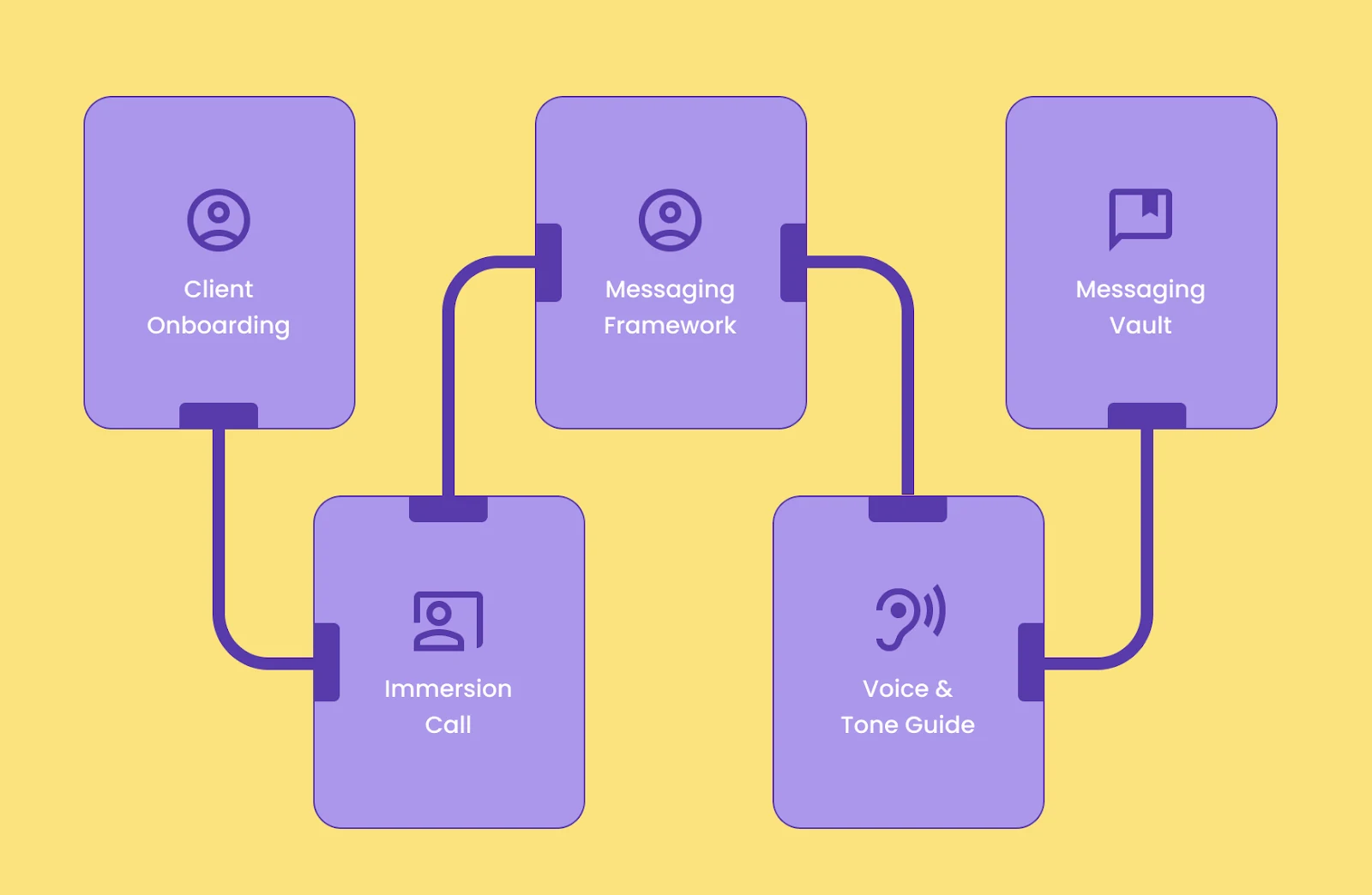
Here’s how the rest of our immersion process looks in action:
- Deep dive into brand guidelines. If the client has one, we study it inside out — tone, voice, taglines, and dos and don’ts. If not, we help them make a quick one.
- Content audit. We audit their website, blogs, ads, and emails to identify existing voice patterns and inconsistencies. This helps us replicate (or refine) the tone they’ve established.
- Stakeholder interviews. Apart from founders or marketers, we sometimes talk to sales or tech to hear how they describe the product to users. It rounds out the picture.
The outcome? By the time a brief lands on our desk, we’re already writing like an extension of the brand, rooted in its voice, grounded in user insight, and clear on what it stands for.
This clarity upfront saves hours downstream.
A journey through the product demo
Before pen hits paper (or fingers hit keyboard), we invest time in deeply understanding two things: the product and its users.
Every copy request starts with a structured briefing process where we align on the primary benefit that users must know. This is possible as we go through the product demo to get a picture of its features.
Post that, we flesh out what we’ve learned with a user-first mindset, ensuring our copy is driven by empathy. We hate self-indulgent brand messaging — it works for no one (DJT being the exception, ofc).
For example, while writing a landing page for a cybersecurity SaaS, we didn’t just say:
Our platform detects and prevents security threats.
Instead, we framed it in a way that mattered to the user:
Stop breaches before they happen. Detect, analyze, and neutralize threats in real time without slowing down operations.
The difference? One is informational, the other is impactful.
The 20-minute research sprint
Before writing, we run a quick but targeted research sprint to get into the user’s head:
- Scan competitor pages
- Browse Reddit threads, Twitter, and G2 for real customer language
- Check past top-performing ads via the Meta Ads Library
Pro tip: we once improved landing page conversions by 28% just by using exact phrases from G2 reviews in our subheads.
This isn’t research for research’s sake. We absorb language that already resonates so we can borrow (or steal) it for better results.
Picking the right template
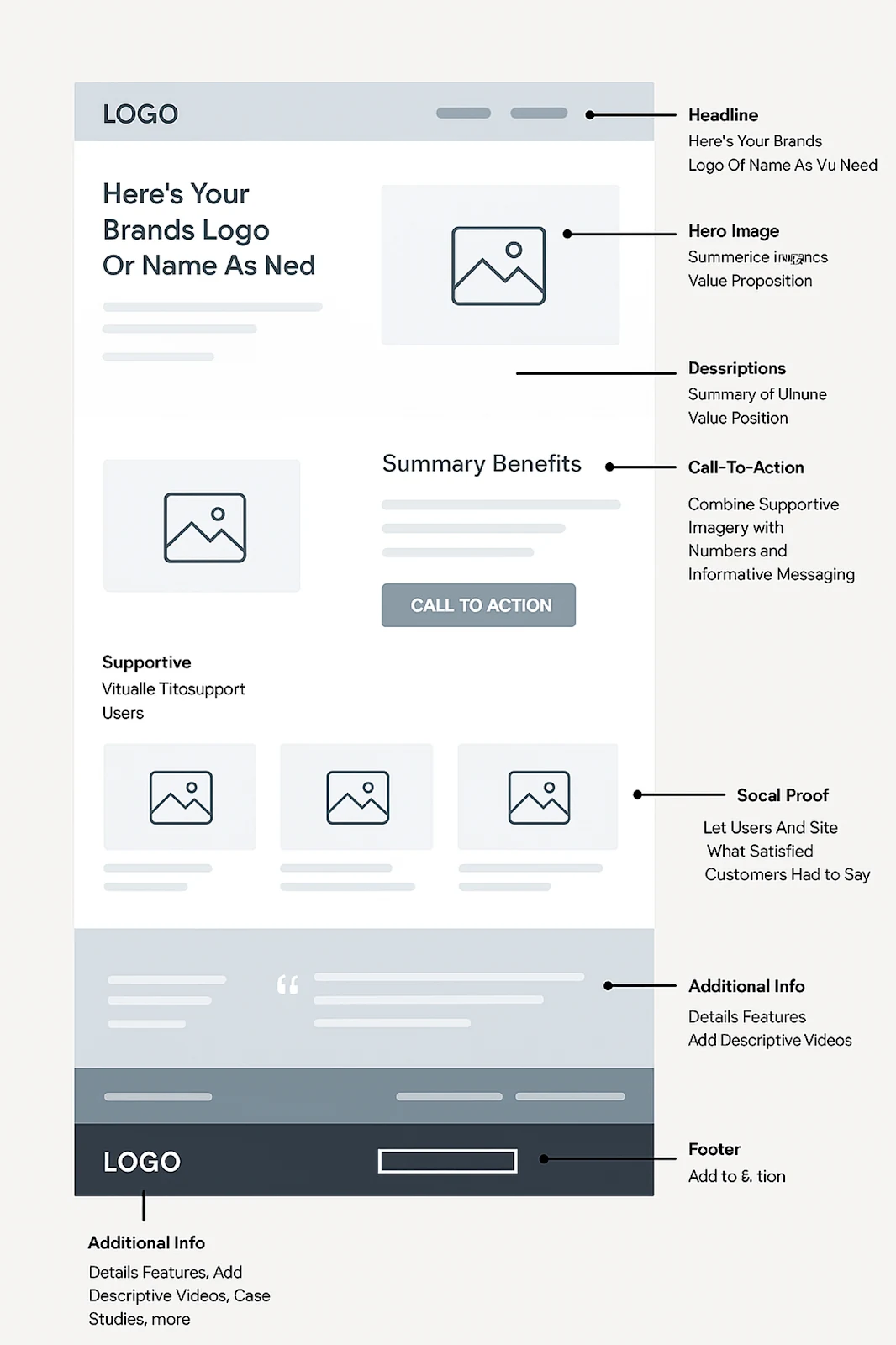
With a lean team, efficiency is non-negotiable. Over time, we’ve built a library of templates and best practices for every type of request — landing pages, LinkedIn ads, email campaigns, Google search ads, comparison pages, and more.
These templates serve as a starting point, a framework that allows us to move faster while keeping quality intact.
For example, our high-performing LinkedIn ad formula looks like this:
Hook → Pain point → Solution → CTA
This structure ensures every ad grabs attention, resonates with the user, and drives action, without reinventing the wheel each time.
Batching requests = fewer tabs, better copy
One of the most underrated moves in our playbook? Batching requests from the same client.
When we receive multiple requests from a client — say, a landing page, a retargeting ad, and a cold email — we group them and tackle them together. It helps keep the brand voice, product nuance, and user persona fresh in our heads. This minimizes context switching and maximizes depth.
Of course, this also means we sometimes push back on scattered deadlines. We negotiate delivery windows with the client so we can work in focused sprints instead of jumping between brands every few hours.
This batching strategy lets us:
- Write faster and deeper with clearer context
- Reuse and remix key messages across formats
- Stay in the client’s world longer, which improves creative output
We’ve found that just this one tweak — request batching — cuts turnaround time by up to 30% for multi-asset briefs.
Only AI for speed and blank-page syndrome
Yes, we are four people on the team, but it’ll be amiss not to mention our honorary teammates. We use tools like:
- Claude + DeepSeek for ideation, headline variations, and cold outreach sequences
- Hemingway + Grammarly for final polish — tightening structure, tone, and grammar
- Fathom for automatically recording and transcribing feedback calls so we never lose the context
Here’s how it fits into our workflow:
- When we get a new request, we first use our internal template as a base
- Then we plug the brief into Claude or DeepSeek, using our custom prompt library (built over time) to get multiple versions of intros, CTAs, or hooks
- For instance, while working on a four-ad copy set for a SaaS RevOps client, we ran three AI-assisted variations to explore different angles: humor, fear-based, and direct benefit. We picked the most promising ones and refined them manually to match the client’s voice
This does three things:
- Saves us hours in the ideation stage
- Gives us options we may not have arrived at alone
- Lets us focus more energy on the strategy behind the copy
We don’t use AI to hit publish; we use it to get unstuck. The human layer still does the thinking, sharpening, and storytelling. And that’s where the magic happens.
Structuring feedback (and why it matters)
We don’t treat feedback as a post-delivery fix. It’s baked into the process. Here’s how:
- Every feedback call is recorded and transcribed by an AI notetaker
- Key takeaways are added to the client’s copy tracker
- We document voice changes, stakeholder preferences, and messaging pivots
- We maintain a repository of feedback in one place for greater visibility. This helps every stakeholder — copywriters, campaign managers, and clients — know what worked and what did not over time
That means fewer repeat edits in every successive request and a tighter working relationship.
Within the first three to four requests, we usually hit a point where clients say, “This is exactly how we’d say it.” And that’s an outcome of process we repeat again and again.
How we test copy: the experimentation framework
Copy without context is just… words. That’s why we don’t just write and ship. We test. Relentlessly.
Every piece of copy we write — whether it’s an ad, a headline, or a CTA — is a hypothesis. And like any good hypothesis, it deserves to be tested. Here’s a peek into our experimentation framework.
1. A/B testing variations at every touchpoint
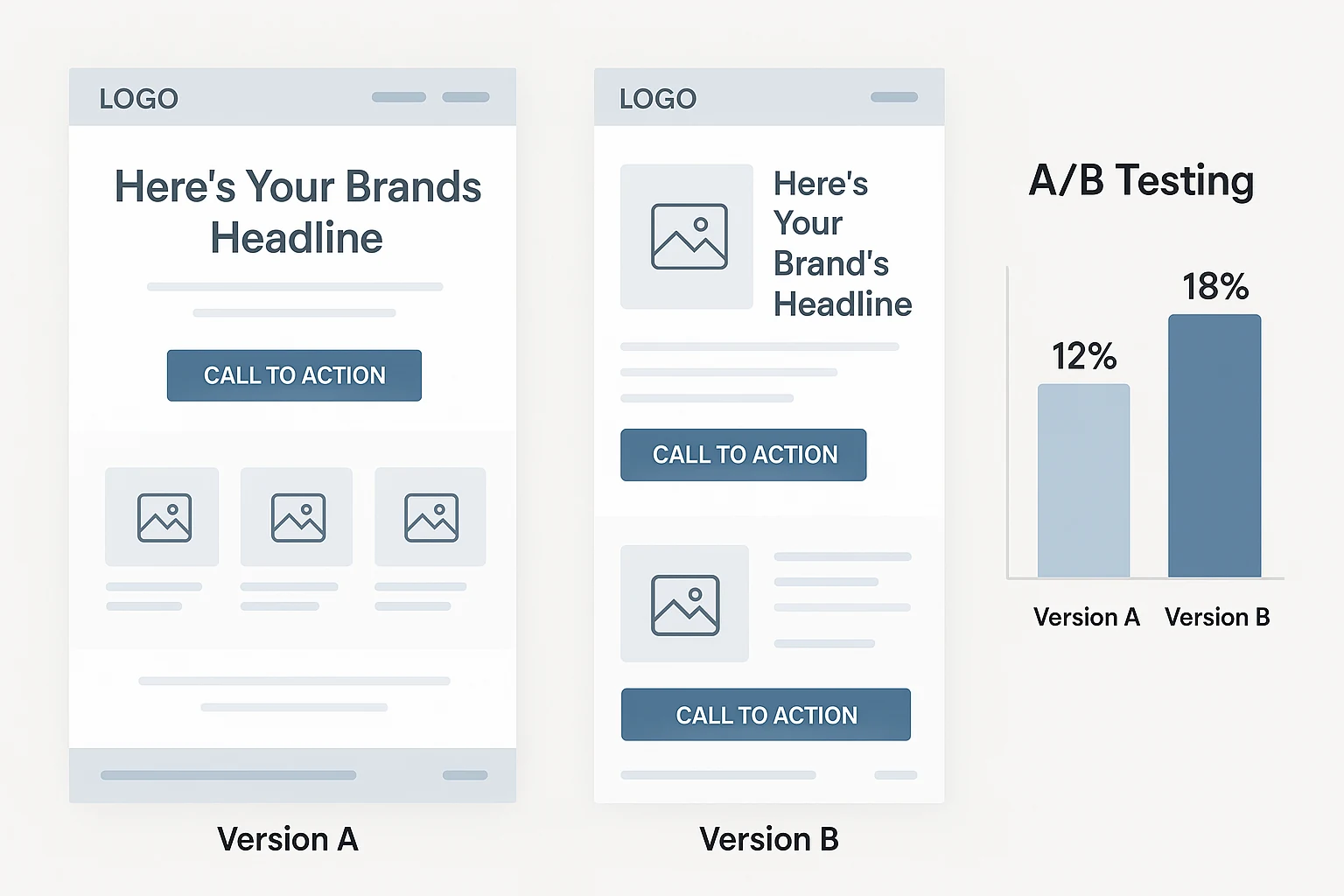
We never assume our first draft is the best. For landing pages and ads, we almost always create multiple versions of the same asset with key variations in:
- Headline hooks
- Subheads and lead-in copy
- Value proposition phrasing
- CTA placement and tone
- Emotional levers (urgency vs curiosity vs FOMO)
For example, on a recent landing page for a compliance SaaS, we tested:
- Version A (straightforward): “Get audit-ready in days, not weeks”
- Version B (aspirational): “From chaos to compliance — faster than you think”
Surprise: Version B outperformed Version A by 41% in sign-up rate. Why? It spoke to the emotional relief of the user, not just the functional benefit.
2. Controlled rollouts with real-time feedback
Before scaling any ad or landing page to 100% of the audience, we roll it out to a small segment (10–20%) to gather initial performance data. Metrics we obsess over:
- Click-through rate
- Bounce rate
- Time on page
- Conversion rate
This lets us double down on what’s working and quietly retire what’s not.
3. Message testing across channels
Sometimes, we repurpose the same message angle across LinkedIn, Google Search, and outbound email to see where it resonates best.
For instance, for a sales enablement client, we tested the same value prop:
- On LinkedIn ads: a punchy visual with “Turn every rep into a top performer”
- On search ads: “Sales enablement platform for B2B teams”
- On cold emails: a first-line opener with “What if 80% of your team hit 120% quota?”
The insight? While it worked okay on search, it crushed it on cold email and LinkedIn. We then refined the entire campaign around that voice.
4. Learn, document, iterate
Every test — win or fail — is logged in our internal copy experimentation sheet. This includes the hypothesis, the variants, the performance data, and the learnings.
We regularly revisit this sheet to:
- Spot high-performing patterns (question-led hooks outperform statement ones)
- Avoid repeating dead angles
- Sharpen future briefs with real insights
Over time, this has become our own little copywriting lab. And the best part? It gives us clarity and confidence to push bold ideas, not just safe ones.
Scaling creativity without compromise
TripleDart’s copy and creative process pays maximum heed to delivering messaging that converts.
Our lean but highly efficient team — powered by structured workflows, deep research, a content repository, set expectations, the right balance of technology and human insight, and a relentless commitment to understanding users — ensures that every campaign we touch drives impact.
Here I have learned that (a lot of) great copy isn’t about the number of writers. It’s about having the right ones, following an optimized process, and having a shared desire to become better each day.